



Hypertensive heart disease refers to heart problems that occur because of high blood pressure that is present over a long time.
Causes
High blood pressure means the pressure inside the blood vessels (called arteries) is too high. As the heart pumps against this pressure, it must work harder. Over time, this causes the heart muscle to thicken.
Because there are often no symptoms with high blood pressure, people can have the problem without knowing it. Symptoms most often do not occur until after many years of poor blood pressure control, when damage to the heart has occurred.
Eventually, the muscle may become so thick that it does not get enough oxygen. This can cause angina (chest pain). Without appropriate blood pressure control, the heart muscle can weaken over time and heart failure may develop.
High blood pressure also leads to thickening of the blood vessel walls. When combined with cholesterol deposits in the blood vessels, the risk of heart attack and stroke increases.
Hypertensive heart disease is the leading cause of illness and death from high blood pressure.
When to Contact a Medical Professional
Contact your health care provider if you have high blood pressure and develop any symptoms or if your blood pressure is not at your target level.
Prevention
Diagnosing high blood pressure early can help prevent heart disease, stroke, eye problems, and chronic kidney disease.
Most people age 18 and older should have their blood pressure checked every year. More frequent measurement may be needed for those with a history of high blood pressure readings or those with risk factors for high blood pressure.
Guidelines can change as new information becomes available, Therefore, your provider may recommend more frequent checks based on your blood pressure levels and other health conditions.
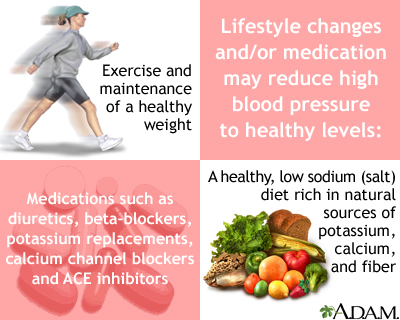
If your blood pressure is high, you need to lower it and keep it under control.
- Do not stop or change high blood pressure medicines without talking to your provider.
- Carefully control diabetes and high cholesterol.
Alternative Names
Hypertension - hypertensive heart; High blood pressure - hypertensive heart
Patient Instructions
References
Flack JM. Arterial hypertension. In: Goldman L, Cooney KA, eds. Goldman-Cecil Medicine. 27th ed. Philadelphia, PA: Elsevier; 2024:chap 64.
Laffin LJ, Bakris GL. Systemic hypertension: mechanisms, diagnosis, and treatment. In: Bonow RO, Mann DL, Tomaselli GF, et al, eds. Braunwald's Heart Disease: A Textbook of Cardiovascular Medicine. 13th ed. Philadelphia, PA: Elsevier; 2026:chap 24.
Rogers JG, O'Connor CM. Heart failure: epidemiology, pathobiology, and diagnosis. In: Goldman L, Cooney KA, eds. Goldman-Cecil Medicine. 27th ed. Philadelphia, PA: Elsevier; 2024:chap 45.
US Preventive Services Task Force; Krist AH, Davidson KW, et al. Screening for hypertension in adults: US Preventive Services Task Force Reaffirmation Recommendation Statement. JAMA. 2021;325(16):1650-1656. PMID: 33904861 pubmed.ncbi.nlm.nih.gov/33904861/.
Writing Committee Members; Jones DW, Ferdinand KC, et al. 2025 AHA/ACC/AANP/AAPA/ABC/ACCP/ACPM/AGS/AMA/ASPC/NMA/PCNA/SGIM Guideline for the prevention, detection, evaluation and management of high blood pressure in adults: A Report of the American College of Cardiology/American Heart Association Joint Committee on Clinical Practice Guidelines. Hypertension. 2025;82(10):e212-e316. PMID: 40811516 pubmed.ncbi.nlm.nih.gov/40811516/.
Review Date 1/27/2026
Updated by: Thomas S. Metkus MD, PhD, Associate Professor of Medicine and Surgery, Johns Hopkins University School of Medicine, Baltimore, MD. Also reviewed by David C. Dugdale, MD, Medical Director, Brenda Conaway, Editorial Director, and the A.D.A.M. Editorial team.